The Blind Side of Car Insurance
You Think "Full Coverage" Means You're Safe. You're Not.
They told you they'd "take care of everything." That's not a promise. That's a sales pitch.
You've been paying your insurance premium every month without fail. When someone asked if you were covered, you said yes — confidently. You have full coverage. You're protected.
Then the crash happens. And somewhere between the emergency room and the first call from an adjuster, you discover that "full coverage" doesn't actually mean what you thought it meant.
In Florida, "full coverage" is not a legal term. It's a misleading term. It's a marketing phrase. It typically refers to a combination of collision coverage (which pays to repair your car) and comprehensive coverage (which covers theft, weather, and non-collision damage). What it does not guarantee is that you're protected from a serious bodily injury caused by the driver who just ran a red light.
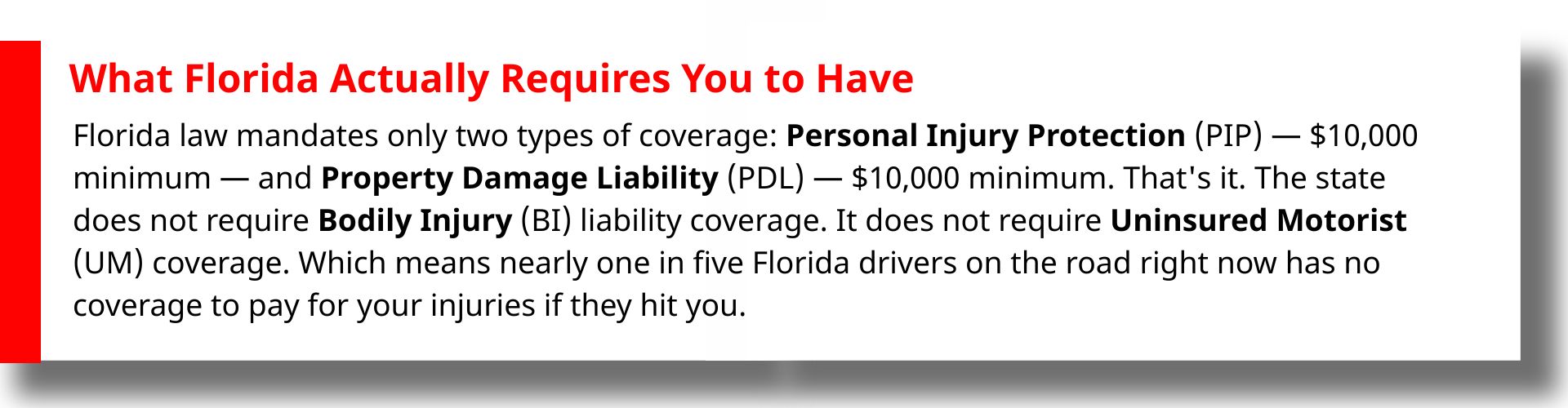
Here's the scenario that breaks people. You're hit by a driver with minimum coverage — or no coverage at all. You're seriously injured. Your medical bills climb past $50,000. You file a claim against the at-fault driver and discover they have $10,000 in bodily injury coverage. Or zero. That's all you're getting from them. Unless you bought Uninsured Motorist (UM) coverage on your own policy, you're covering the rest yourself.
This is the situation Matt Carlucci — a seasoned insurance agent and Jacksonville city council member — unpacks in Episode 1 of Not Another TV Lawyer. The problem isn't that people are careless. The problem is that the phrase "full coverage" actively misleads people into believing they've handled something they haven't. Agents sometimes don't clarify it. Policies don't lead with it. And victims only discover the gap when it's too late to fill it.
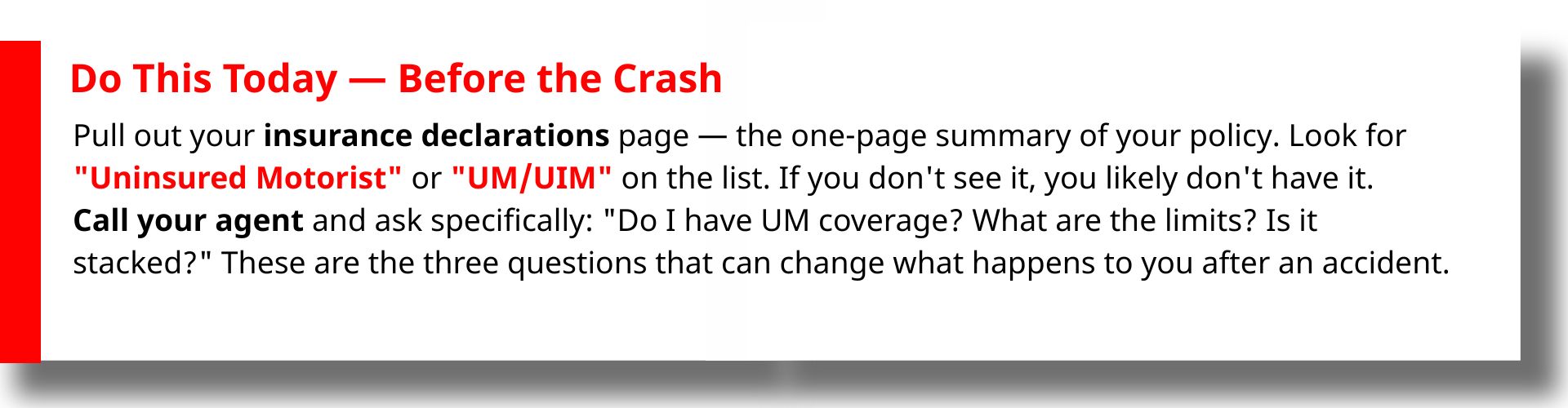
Uninsured Motorist coverage is what personal injury attorneys consistently call the single most important coverage you can buy in Florida. It covers your own injuries when the at-fault driver has no insurance or not enough of it. It's also relatively inexpensive — typically $50 to $200 for a six-month policy depending on your limits. The difference in premium between minimal and substantial UM coverage is often less than a tank of gas per month.
If you drive more than one vehicle, ask your agent about stacked UM coverage— a policy structure that combines the UM limits across all your vehicles. A family with two cars at $300,000 UM each could have $600,000 of protection stacked. Without stacking, they'd have $300,000.
Contact us or visit our MTSJAX.FM Show Page for more about our podcast
Our Episode Guests:
Matt Carlucci
Matt Carlucci is a State Farm Insurance Agent and a Jacksonville City Council member. You can reach Matt Carlucci’s agency via their website at mattcarlucci.com or by calling 904-399-5544. He and his team are dedicated to helping you manage your risk with the best possible coverage at a price you can afford.
Sarah Johnson
Sarah Johnson and her family live in Jacksonville, Florida. She is the busy mom of 2 girls, 2 dogs, and 2 cats. She is a Halloween fanatic and loves being outdoors and active.
Episode Notes:
This episode covers the common misconception of 'full coverage,' statutory minimums, personal injury protection (PIP), and the significance of uninsured motorist coverage. Matt emphasizes the importance of tailoring insurance plans to individual needs and protecting oneself against potential risks. Listeners gain valuable insights on managing insurance effectively while navigating the complexities of auto insurance policies.
00:00 Introduction to Auto Insurance with Sarah Johnson
00:06 The Reality of Uninsured Drivers
00:40 Understanding Auto Insurance Coverage
01:36 The Myth of Full Coverage
03:20 Meet the Guest: Matt Carlucci
06:01 The Importance of Adequate Coverage
07:46 Statutory Minimums and PIP Explained
12:54 Liability and Umbrella Policies
19:41 Uninsured Motorist Coverage
30:07 Conclusion and Contact Information